
Introduction
Is your school still trapped in a cycle of manual data entry, fragmented communication, and “spreadsheet fatigue”? In 2026, the traditional School ERP has evolved from a simple database into a living, breathing AI-driven ecosystem. If you are still using software that just “records” data rather than “analyzing” it, you are leaving thousands of administrative hours and significant revenue on the table.
The problem isn’t just about going digital; it’s about EdTech interoperability and staying ahead of shifting global standards like the NEP 2020 and the 2025/2026 Data Protection Acts. Many school owners struggle with SaaS education platforms that are too complex for teachers and too disconnected for parents. This guide will dismantle those barriers. We aren’t just talking about digital attendance; we are diving deep into predictive analytics, automated fee recovery, and the “Intelligent” school management system 2026 demands.
In this definitive guide, specifically designed for school owners and principals, we will explore the transition from a legacy Student Information System (SIS) to eSchool ERP—the gold standard for cloud-based school automation. We will cover the ROI of automation, cybersecurity compliance, and the exact roadmap to choosing a vendor that actually grows your institution.
Core Modules vs. 2026 Innovations in School ERP
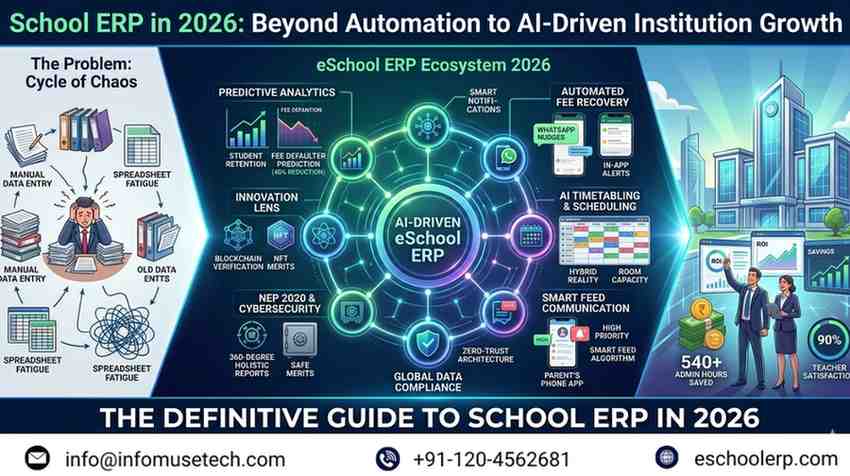
The standard modules of 2020—attendance, fees, and exams—are now “table stakes.” To lead in 2026, your School ERP must leverage AI-powered adaptive timetabling and neural networks to solve complex institutional hurdles.
The Shift from Databases to Predictive Analytics
Modern schooling requires foresight. While old systems told you who was absent yesterday, eSchool ERP tells you which student is likely to drop out or which parent is likely to default on fees next month based on behavioral patterns.
Automated Fee Recovery: Reducing Defaulters by 40%
The biggest pain point for any school owner is the “Fee Follow-up.” In 2026, eSchool ERP uses predictive analytics for fee defaulters. Instead of generic reminders, the system analyzes payment history and sends hyper-personalized, nudge-based notifications via WhatsApp and In-App alerts.
- The Result: Schools using eSchool ERP report a 40% reduction in late payments within the first six months.
AI-Powered Adaptive Timetabling
Creating a timetable used to take weeks. With the “Hybrid Reality” of 2026—where some classes are bridge-linked with home learners—conflict resolution is a nightmare. Our AI-driven engine handles automated grading systems and scheduling in seconds, accounting for teacher availability, room capacity, and even “energy levels” of subjects (e.g., placing Math before PE).
Solving “Communication Fatigue” (The Parent-Teacher App Gap)
Parents in 2026 are overwhelmed. They don’t want 50 notifications a day; they want reader retention and meaningful insights.
eSchool ERP solves this through “Smart Feed” technology. Similar to a social media algorithm, it prioritizes what a parent needs to see:
- High Priority: Fee dues, emergency holidays, or significant grade drops.
- Low Priority: Daily cafeteria menus or general newsletters.
Real-World Comparison: The “Engagement” Table
| Feature | Legacy Systems (2020) | eSchool ERP (2026) |
| Messaging | One-way SMS (Paid) | Unlimited AI-Chatbot & App Push |
| Progress Tracking | Half-yearly Report Cards | Real-time Skill Competency Maps |
| Feedback | Annual PTA Meetings | Instant Digital Sentiment Polls |
| Homework | PDF attachments | Interactive Modules via Integrated LMS |
Security & Compliance: Navigating Global Data Protection Acts
With the 2025/2026 data protection laws now in full effect, school owners are legally responsible for student data sovereignty. Most “cheap” ERPs store data on unencrypted local servers.
eSchool ERP utilizes Zero-Trust Architecture:
- End-to-End Encryption: Student records are encrypted at rest and in transit.
- Data Sovereignty: We ensure your data stays within your national borders, complying with local NEP 2020 compliance and international privacy standards.
- Automated Audits: The system generates monthly security logs, ensuring no unauthorized staff member can access sensitive financial data.
[Case Study] How St. Xavier’s Global Saved 500+ Admin Hours in One Semester
In 2025, St. Xavier’s Global Academy was struggling with manual enrollment and chaotic fee reconciliation. They switched to eSchool ERP to streamline their SaaS education platform experience.
- The Challenge: 1,200 students, 15% fee leakage, and 4 full-time staff dedicated just to data entry.
- The Solution: Implemented eSchool ERP’s cloud-based school automation with integrated biometric attendance and automated payment gateways.
- The Result: * Time Saved: 540 admin hours per semester.
- Revenue Recovered: ₹12 Lakhs in previously “forgotten” dues.
- Teacher Satisfaction: 90% of teachers reported reduced stress due to automated grading systems.
5 Red Flags to Watch for When Choosing a Vendor in 2026
Not all School Management Systems 2026 are created equal. Avoid vendors who:
- Lack API Interoperability: If the ERP doesn’t connect to your accounting software (like Tally) or your GPS tracking system, it’s a silo.
- Hidden Costs: Watch out for “Per SMS” charges or “Implementation fees” that double the quote.
- No Offline Mode: In areas with patchy internet, a 100% cloud-dependent system can paralyze your front desk.
- Poor Mobile UX: If the Principal’s dashboard isn’t mobile-optimized, you’re tethered to your desk.
- Slow Support: In 2026, you need a 2-hour ticket resolution, not a 2-day wait.
The 2026 School Efficiency Formula (ROI Calculator)
As a school owner, you need to see the numbers. Use this The 2026 School Efficiency Formula to calculate your projected annual savings:
The ROI Equation
$$Annual Savings = (M_h \times R) + (F_d \times 0.15) – S_c$$
- $M_h$: Total Manual Hours saved (Staff & Teachers).
- $R$: Average Hourly Rate of staff.
- $F_d$: Total overdue Fee Defaulters amount (AI recovery rate is ~15%).
- $S_c$: Annual Software/Subscription Cost.
ERP ROI Calculator Table (Example for 1000 Students)
| Expense Category | Manual Process | With eSchool ERP | Annual Savings |
| Admin Salaries | ₹15,00,000 | ₹9,00,000 | ₹6,00,000 |
| Paper & Printing | ₹2,50,000 | ₹50,000 | ₹2,00,000 |
| Fee Leakage | ₹10,00,000 | ₹2,00,000 | ₹8,00,000 |
| Communication (SMS) | ₹1,50,000 | ₹0 (App Based) | ₹1,50,000 |
| TOTAL SAVINGS | ₹17,50,000 |
Advanced Tips for School Management System 2026
To truly stay ahead, you must look at EdTech interoperability and future-proof technologies.
- Blockchain for Degree Verification: In 2026, eSchool ERP allows schools to issue “Tamper-Proof” digital certificates. This eliminates the risk of fake degrees and makes the verification process instant for universities.
- NFT Merits: Incentivize student behavior using “Digital Merits” or NFT badges that students can showcase in their digital portfolios.
- Hybrid Sync: Ensure your ERP can handle “Rotating Classrooms” where 50% of students are physical and 50% are virtual, syncing their attendance and participation in one unified dashboard.
FAQ: Common Questions from School Owners
Is eSchool ERP better than Open source vs. White-label school management software?
Open source requires a dedicated IT team to manage bugs and security. eSchool ERP is a managed SaaS education platform, meaning we handle the security, updates, and server maintenance while you focus on education.
How long does the migration take?
Most schools fear data loss. With our “Rapid-Migrate” tool, we can transition your data from Excel or your old Student Information System (SIS) to eSchool ERP in less than 7 working days with zero downtime.
Is it compliant with NEP 2020?
Yes. We have built-in modules for 360-degree holistic report cards, competency-based assessments, and vocational integration as mandated by the National Education Policy.
Can I manage multiple branches?
Absolutely. Our “Multi-School Command Center” allows owners to see the financial and academic health of all their branches from a single login.
H3: What about data privacy for students?
We use military-grade encryption and are fully compliant with the latest Global Data Protection Acts. Your data is your property; we are just the vault.
Conclusion
The decision to upgrade your School ERP is no longer just a technical one—it is a strategic business move. In 2026, the gap between “Tech-Forward” schools and “Traditional” schools is widening. Schools that leverage cloud-based school automation and AI-driven analytics will see higher enrollment, better parent retention, and significantly higher profit margins.
Key Takeaways for School Owners:
- Automation is not enough: You need predictive AI to solve fee and attendance issues.
- Compliance is a shield: Protect your institution from legal data liabilities.
- ROI is measurable: A good ERP pays for itself within the first 12 months.
- Focus on UX: Choose a system that teachers and parents want to use.
Ready to see the future of your school?
Don’t let manual processes hold your vision back. Join 500+ elite institutions that have scaled with eSchool ERP.
[CTA] Download our “2026 School Digital Transformation Roadmap (PDF)” — A 10-page workbook for School Owners to map their current manual processes against digital equivalents, including a vendor comparison scorecard.
Website: eschoolerp.com
Headquarters: B-21, Sector 63, Noida, Uttar Pradesh – 201301, India
Business Hours: Mon-Fri | 9:30 AM – 6:30 PM
Email: info@infomusetech.com
Mobile: +91-9891216722, +91-9968033748
Landline: +91-120-4562681
Request a Free Demo
[5 Proven Ways/2026 Update] How to Automate Your Campus with the Best School ERP in India?
E-School ERP: Cloud-Based School ERP with LMS, Mobile Apps & K–12 Content
1 thought on “The Definitive Guide to School ERP in 2026: Beyond Automation to AI-Driven Institution Growth”