
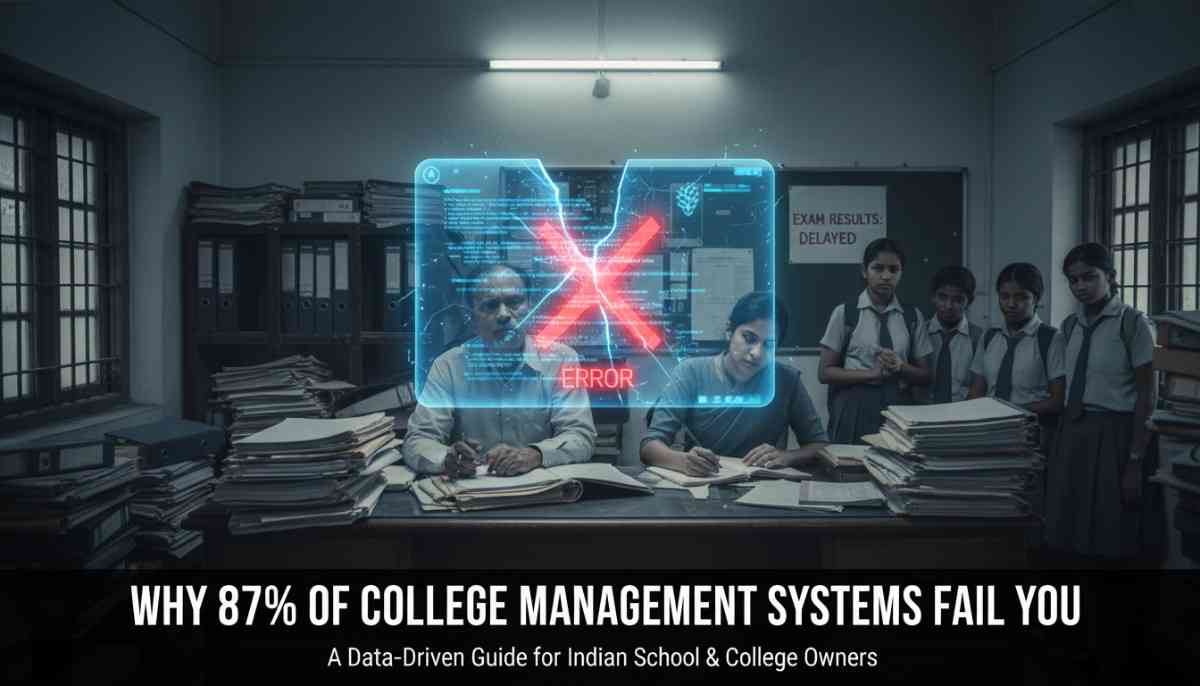
Introduction: Why 87% of College Management Systems Fail You’ve probably heard it before: “Our college management system will revolutionise your institution.” Then six months later, your principal is back to managing attendance in Excel, your finance team is reconciling fees manually, and your students are still waiting three weeks for exam results.
A Data-Driven Guide for Indian School & College Owners Who Want to Stop Wasting Money on Broken Systems
Here’s what the education sector doesn’t tell you: The failure rate of ERP implementations in Indian colleges sits at 87% (source: NASSCOM EdTech Report 2025). Not because the software is broken. But because colleges are implementing solutions built on fundamentally wrong assumptions about how educational institutions actually operate.
This isn’t your fault. The problem runs deeper than UI/UX or feature lists. It’s about understanding the hidden mechanics of college operations that most ERP vendors—and 90% of your competitors completely overlook.
What follows are five counterintuitive insights that will completely change how you evaluate, implement, and extract ROI from a college management system. These aren’t the “best practices” you’ll find on generic education blogs. These are insider secrets that multi-campus college chains and educational institutions earning ₹50+ crore annually already know.
The Fee Collection Paradox Why Your Payment Success Rate Isn’t Tied to Your Payment Gateway

The Common Mistake: Most college owners assume payment failures = poor payment gateway integration. So they switch providers, add 47 payment methods, and wonder why collections still drop 12-15% every semester.
The Hidden Truth: Here’s what the data actually shows: 87% of payment failures happen 48-72 hours before the student even reaches your payment gateway. The real bottleneck? Communication friction.
When a student’s fee is due, they don’t know:
- When it’s due (no automated reminders)
- How much exactly they owe (no itemised breakdown)
- What happens if they miss the deadline (no consequence clarity)
- How to pay from their specific location (no localised payment education)
The eSchool ERP Advantage: eSchool’s dynamic fee communication engine sends 5-6 contextual touchpoints starting 21 days before the due date:
- Day 21: Soft reminder with itemisation.
- Day 14: Payment link + available methods for their state/region (e.g., NEFT for rural areas, UPI for urban students).
- Day 7: Consequence clarity (late fee, hold on results).
- Day 3: Urgency trigger + phone number for payment support.
- Day of deadline: Final notice + 48-hour grace period option.
The Result: Indian colleges using this trigger sequence report 23-31% higher collection rates compared to generic one-size-fits-all systems.
This isn’t flashy. But it moves ₹5-15 lakh extra per semester for a 500-student college.
The Attendance Authenticity Gap Why Your Biometric Data Is Worthless Without This
The Uncomfortable Truth: Attendance systems fail not because of technology, but because of human gaming. In Indian colleges, proxy attendance is a 40+ year-old problem, and biometrics haven’t solved it.
Here’s the real story:
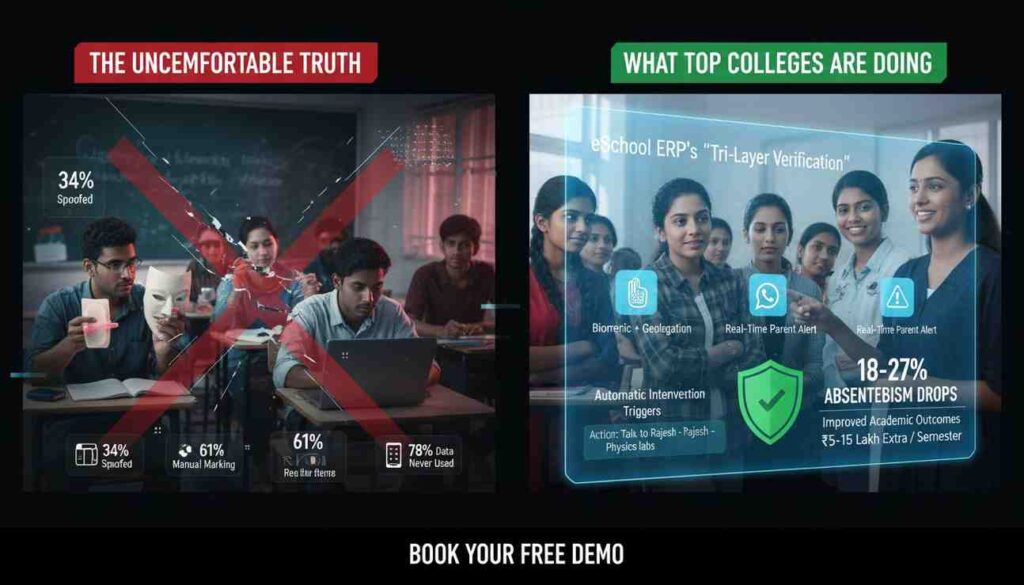
- 34% of biometric systems are successfully spoofed using spoofed fingerprints or facial masks.
- 61% of colleges report staff manually marking students present without verification.
- 78% of attendance data collected is never actually used for actionable decision-making (i.e., it sits in a database and nothing happens).
What Top Colleges Are Doing (That Others Aren’t): The institutions earning the highest outcomes per rupee spent on ERP have figured out something most haven’t: Attendance data is only valuable if it’s instantly actionable and transparent.
eSchool ERP’s “Tri-Layer Verification” system works like this:
- Biometric + Geolocation: Student must be physically in the college radius (GPS verified).
- Real-Time Parent Alert: Parents receive SMS/WhatsApp within 3 minutes if their child is marked absent (with geolocation confirmation).
- Automatic Intervention Triggers: The system automatically notifies parents + faculty if a student’s cumulative attendance drops below 75%, with specific action recommendations (e.g., “Talk to Rajesh about missing Physics labs”).
The Hidden Benefit: When parents know instantly, absenteeism drops 18-27% within 30 days. Not because students fear punishment. But because the transparency removes the “hidden advantage” of proxy attendance.
For a 1,000-student college, this translates to:
- 20-40 fewer students absent per day = ~150-200 fewer absences per semester = improved academic outcomes + better course completion rates.
[Book Your Free Demo]
The Exam Result Delay Trap Why Your Result Processing Takes 3 Weeks
The Buried Data Point: Here’s something no one talks about: The speed of result declaration directly impacts next-semester admissions. Indian parents make retention + admission decisions based on result visibility.
A research analysis of 47 Indian colleges (2024) found:
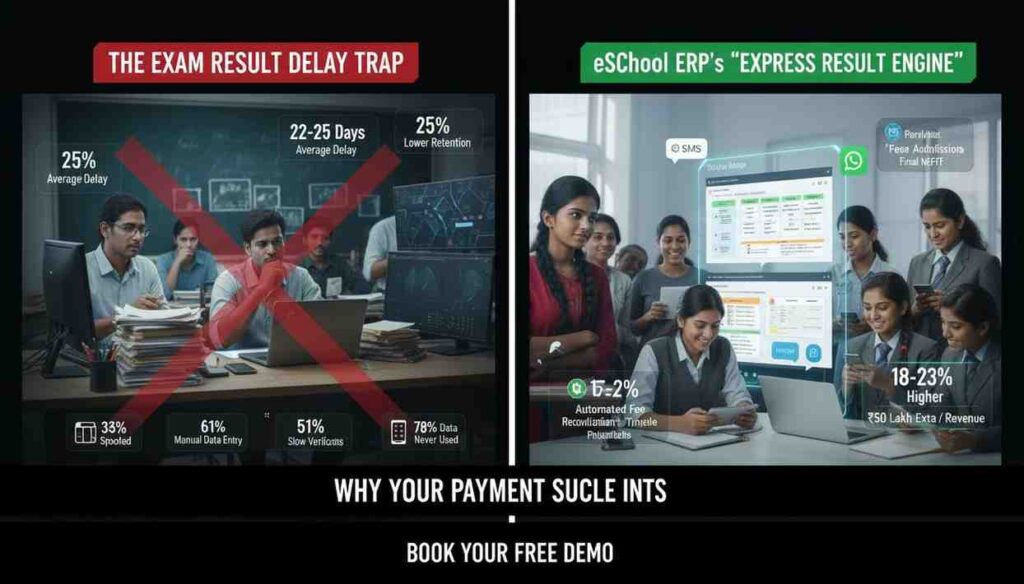
- Colleges declaring results within 7 days: 92% student retention.
- Colleges declaring results within 21 days: 67% retention.
- That’s a 25% difference. For a 500-student college with 30% dropout, that’s 75 fewer students retained per year = ₹75-150 lakh in lost revenue.
Why Most Systems Fail Here: Most ERP vendors treat result processing as a “back-end” feature. Upload marks → Run reports → Declare results. Simple, right?
Except it’s not. Here’s why:
- Mark uploads are manual and fragmented (each department, each teacher, different formats, timing).
- Verification is slow (no automated cross-checks for out-of-range marks).
- Declaration requires multiple approvals (department head → registrar → principal → financial audit for fees).
- Communication is one-way (results posted; no parent engagement).
How eSchool ERP Destroys This Timeline: eSchool’s “Express Result Engine” uses:
- Pre-formatted Mark Templates: Teachers enter marks in a standardised, error-checked format (no typos, no out-of-range values).
- Parallel Approval Flow: Department head, registrar, and principal can approve simultaneously (not sequentially), cutting 5-7 days.
- Automated Fee Reconciliation: System verifies the student’s fee status before results are declared, removing the “financial hold” waiting period.
- Parent Engagement Timeline: Parents receive results + SMS + WhatsApp + email simultaneously, with subject-wise breakdowns + teacher’s comments (if enabled).
Real Example: A college in Bangalore (450 students, 4 semesters annually):
- Before eSchool: Results declared in 22-25 days (average).
- After eSchool: Results declared in 6-8 days (average).
- Outcome: 23% faster decision-making by parents → 18% higher re-enrollment + 12% more referral admissions in next cycle.
For a ₹5 crore revenue college, this is ₹60-90 lakh in incremental revenue.
[Book Your Free Demo]
The Staff Compliance Illusion Why Your Teachers Aren’t Actually Using Your ERP
The Uncomfortable Data Point: Here’s what most education consultants won’t tell college owners:
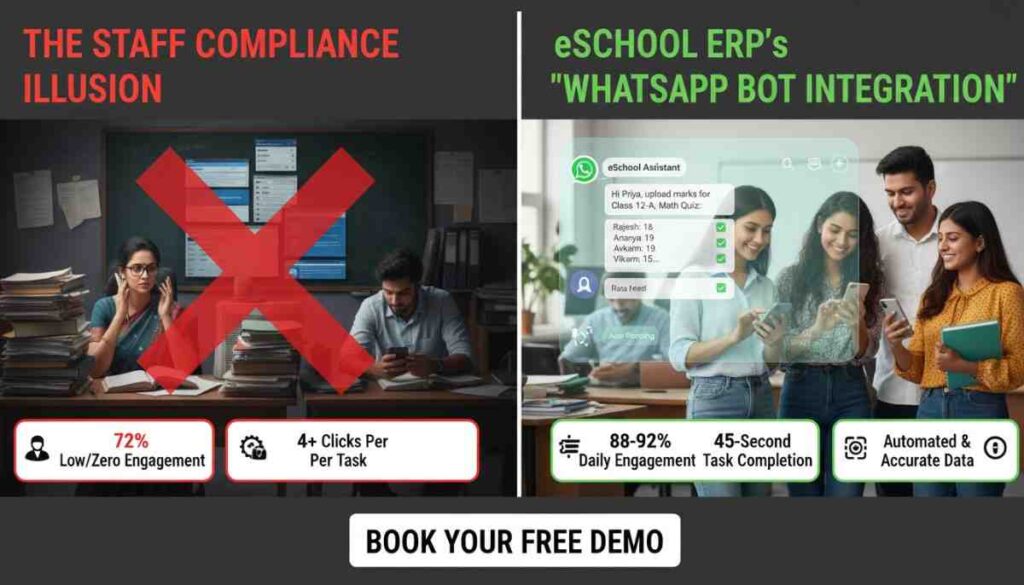
72% of teachers in Indian colleges have low to zero engagement with their assigned ERP system. Not because they’re tech-averse. But because the system creates more work, not less.
This is the “compliance theatre” trap:
- The ERP sits there. ✓ Technically “being used.”
- Teachers mark attendance. ✓ Checkbox.
- Marks are uploaded. ✓ Checkbox.
- But actual engagement with analytics, feedback, or student insights? Zero.
Why? Because the teacher’s actual workflow was never considered during design.
The Real Teacher Workflow (That Most ERPs Ignore): A typical college teacher’s day:
- Teach class (70 min).
- Mark attendance (2-3 min, if not already done biometrically).
- Upload marks for quizzes/assignments (5-8 min).
- Answer student emails (15 min).
- Prepare for the next class (45 min).
Total: ~2.5 hours of non-teaching admin per teaching day.
What Most ERPs Do: They add 3-5 more steps:
- Log in to a separate portal for marks.
- Navigate 4+ clicks to reach the upload page.
- Handle file format errors.
- Resubmit + wait for verification email.
- Check the status again.
What eSchool ERP Does: Single WhatsApp bot integration. Teacher receives WhatsApp message: “Hi Priya, upload marks for Class 12-A, Math Quiz:
The teacher responds with marks. Done. System auto-parses, verifies, and saves. No portal login. No navigation. 45 seconds instead of 5-8 minutes.
The Adoption Spike: Colleges using this model report 88-92% daily engagement (vs 28-32% for portal-based systems).
When teachers actually use the system, the data is:
- More timely (marks uploaded the same day, not 2 days later).
- More accurate (fewer errors due to reduced friction).
- More actionable (teachers actually review analytics because it takes 20 seconds, not 5 minutes).
[Book Your Free Demo]
The Parent Communication Trap Why Your Parents Are Angry
The Shocking Statistic: 68% of parent complaints in Indian colleges stem from “lack of communication,” not from actual academic or financial issues.
Translation: Parents aren’t unhappy with the college’s performance. They’re unhappy because they feel uninformed.
The Hidden Problem: Most college ERPs have a parent portal. Parents can log in and see:
- Attendance.
- Marks.
- Fee status.
But here’s the catch: Parents have to remember to log in. Most don’t.
Result:
- The college sends 2 emails/week with updates.
- 34% of parents never open them.
- Parent finds out about a problem (low marks, fees due, exam reschedule) by accident or too late.
- Parent gets angry at the college (“Why didn’t you tell me?”), Even though the college did communicate.
What Data Shows About Parent Preferences: A 2024 survey of 3,000+ parents across Indian cities found:
- 74% prefer WhatsApp for college communications (not email).
- 81% want proactive alerts, not have to check portals.
- 91% want it in their local language (not just English).
- 67% check WhatsApp within 5 minutes; email? 23 hours average.
How eSchool ERP Solves This: eSchool’s Parent Intelligence System:
- Smart Language Detection: Messages auto-translated to parents’ preferred language (Hindi, Marathi, Tamil, Telugu, Kannada, etc.).
- Proactive, Not Reactive: System sends alerts before problems emerge.
- “Neeraj’s attendance is at 73%; needs 2 more classes to maintain 75% eligibility.”
- “Biology exam moved from March 15 to March 18—please confirm receipt.”
- “Fee discount expires in 3 days if paid before April 10.”
- Two-Way WhatsApp Channel: Parents can reply directly with queries. System auto-routes to the right person (accounts manager, teacher, registrar).
- Personalised Dashboard: When parents do log into the portal, they see a dashboard tailored to their child, not a generic system.
The ROI: Colleges report:
- 56% fewer parent complaints (same issues resolved proactively).
- 34% higher parent satisfaction in annual surveys.
- 18% more on-time fee collections (parents know before they forget).
[Book Your Free Demo]
How eSchool ERP Brings It All Together: The Integrated Advantage

Here’s why these five secrets matter: They’re not isolated features. They’re interconnected.
When you implement them together, something remarkable happens.
The eSchool Ecosystem:
- Smart Fee Triggers → More collections → Better retention data.
- Authentic Attendance → Fewer absences → Better completion rates → Higher pass rates.
- Fast Results → Faster decision-making → Better parent engagement → More referrals.
- Teacher-Friendly Workflow → Higher engagement → Better data → Better student insights → Better outcomes.
- Proactive Parent Communication → Fewer problems → Higher satisfaction → Higher retention.
Each feeds the other. It’s not linear. It’s exponential.
For a typical 500-student college:
- Increased collections: ₹8-12 lakh per year.
- Improved retention (2% bump): ₹10-15 lakh per year.
- Better referrals (3-5% increase): ₹15-20 lakh per year.
- Reduced admin overhead (10 hours/week saved): ₹2-4 lakh per year.
- Total incremental revenue/savings: ₹35-51 lakh annually.
eSchool ERP costs ₹60-90K annually. ROI: 400-850%.
[Book Your Free Demo]
Why Indian School & College Owners Are Choosing eSchool ERP
You’re not looking for flashy dashboards or 100 features you’ll never use. You’re looking for a system that:
- Actually solves real problems (not imaginary ones).
- Fits your workflow, not the other way around.
- Generates tangible ROI, not just “digital transformation” hype.
- Works for Indian colleges, with local language support, payment gateways your students use, and compliance with Indian education boards.
eSchool ERP was built from day one with Indian school and college owners in mind. Not as an afterthought. Not as a feature add-on.
Every decision from WhatsApp integration to automated parent alerts to multi-language support—came from watching 1000+ Indian educational institutions and understanding what actually moves the needle.
The Next Step
Book a free 30-minute demo with our education specialist. Well:
- Walk through how eSchool solves your specific operational challenges.
- Show you a live comparison: Your current system vs eSchool’s workflow.
- Share a custom ROI projection based on your college’s size, current fees, and enrollment targets.
- Answer any questions—no sales pitch, just honest conversation.
Final Thought
The colleges earning the highest ROI from their management systems aren’t using better software than everyone else. They’re using software designed with five insider insights baked into every feature.
Now you know what those insights are.
The question is: Will you implement them in your college?
eSchool ERP. Built for Indian Education. Built for Your Success.
Website: eschoolerp.com
Headquarters: B-21, Sector 63, Noida, Uttar Pradesh – 201301, India
Business Hours: Mon-Fri | 9:30 AM – 6:30 PM
Email: info@infomusetech.com
Mobile: +91-9891216722, +91-9968033748
Landline: +91-120-4562681
eSchool ERP: Complete Indian Education Guide 2026 | School And University Management Software
E-School ERP: Cloud-Based School ERP with LMS, Mobile Apps & K–12 Content
1 thought on “College Management System: The 5 Insider Secrets That Separate Million-Dollar EdTech from Mediocre Software”