
Introduction
Is your school’s administrative backbone still stuck in 2015 while your students are living in 2026? Recent global education surveys show that nearly 65% of school administrators lose over 15 hours a week to manual data entry and fragmented communication. In an era of hyper-personalization, relying on a legacy student management system isn’t just an inconvenience—it’s a risk to your institution’s reputation and growth.
The problem is clear: Traditional “digital registers” can no longer handle the complexity of modern hybrid learning, real-time analytics, and instant Parent-Teacher Communication Portal expectations. You need more than a database; you need an ecosystem. Whether you are managing a K-12 powerhouse or a growing micro-school, the right student management system acts as the “brain” of your campus.
In this guide, we will break down the 2026 standards for institutional excellence, exploring how eSchool ERP transforms chaos into a streamlined, high-ROI operation. From Student Record Management to AI-driven predictive outcomes, here is your roadmap to future-proofing your school.
Core Architecture: What Makes a Modern Student Management System?
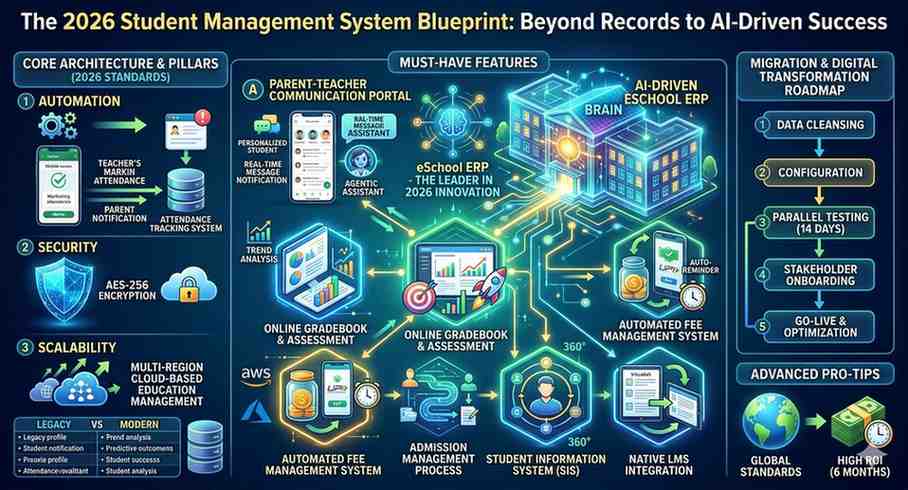
The definition of school “management” has shifted from simple record-keeping to proactive data orchestration. A modern student management system in 2026 is built on three pillars: Automation, Security, and Scalability.
From Static Databases to Real-Time Data Ecosystems
Gone are the days when data was “synced” at the end of the day. Modern systems use Cloud-based Education Management to ensure that when a teacher marks a student absent on their mobile app, the parent receives a notification within seconds. This real-time flow is the difference between a reactive school and a proactive one.
The Role of AI in Predictive Student Outcomes
In 2026, we don’t just look at past grades; we predict future performance. By integrating a sophisticated Online Gradebook and Assessment tool, eSchool ERP uses trend analysis to identify students at risk of falling behind before the mid-terms happen.
Actionable Steps for Modern Architecture:
- Audit your current latency: Is data updated instantly across all departments?
- Prioritize Mobile-First: Ensure your School ERP Software has native apps for teachers and parents.
- Check API Readiness: Your system must talk to external tools like Zoom, G-Suite, or specialized Fintech apps.
- Data Residency: Confirm your provider complies with the 2026 Data Privacy Acts.
- User Experience: If your staff needs a 50-page manual to use the software, it’s the wrong software.
| Feature | Legacy Systems (Pre-2024) | Modern eSchool ERP (2026) |
| Data Storage | Local Servers / Basic Cloud | Multi-Region Cloud-based Education Management |
| Fee Collection | Manual / Cash / Bank Visits | Automated Fee Management System |
| Analytics | Static PDF Reports | Real-time AI Dashboards |
| Communication | Printed Circulars / SMS | Integrated Parent-Teacher Communication Portal |
7 Must-Have Features for the 2026 Academic Landscape
To stay competitive and ensure maximum reader retention (or in your case, student retention), your student management system must go deeper than the basics.
1. Automated Compliance & Data Residency
With evolving education laws, your Student Information System (SIS) must automatically update compliance reports for local and national boards.
2. Hyper-Personalized Parent-Teacher Portals
Parents no longer want a generic newsletter. They want a personalized feed of their child’s Attendance Tracking System data, upcoming tests, and library dues.
3. Seamless LMS Integration
The line between admin and academics is blurred. Your ERP must have native LMS Integration to allow teachers to push assignments directly from the syllabus to the student portal.
4. The “Agentic” Admin Assistant
AI agents within eSchool ERP can now handle routine queries like “What is my current balance?” or “When is the next PTA meeting?” via the portal without human intervention.
5. Comprehensive Student Record Management
A 360-degree view of the student—including health records, extracurricular achievements, and behavioral logs—all in one encrypted file.
6. Automated Fee Management System
Reduce your overhead by automating invoice generation, late fee calculations, and online payment reconciliations.
7. Streamlined Admission Management Process
From the first lead to the final enrollment, the Admission Management Process should be a paperless, friction-free journey for prospective parents.
Transitioning from Legacy: A 5-Step Migration Framework
Switching your student management system feels like open-heart surgery for your school. However, with eSchool ERP, we’ve refined the migration into a 5-step “Safe-Transition” framework.
- Data Cleansing: Export your current Student Record Management data and remove duplicates.
- Configuration & Mapping: Align your school’s unique grading scales and fee structures within the new School ERP Software.
- Parallel Testing: Run your new Attendance Tracking System alongside your old method for exactly 14 days to ensure zero data loss.
- Stakeholder Onboarding: Roll out the Parent-Teacher Communication Portal with a “Welcome Kit” to ensure 100% adoption.
- Go-Live & Optimization: Transition fully to the cloud and begin using the Online Gradebook and Assessment modules.
Stop wasting ₹2L/month on staff data entry. Our Education ERP Software uses WhatsApp-UI & Zero-Click Fees. Top Rated 2026. Explore Features | Get 30-Day Free Trial.
Common Mistakes + Fixes in School Digital Transformation
Many school owners invest in a student management system only to see it become “shelfware.” Avoid these pitfalls:
- Buying for the Price, Not the Value: A cheap system often lacks LMS Integration, leading to fragmented data.
- Ignoring Staff Training: If teachers find the Online Gradebook and Assessment tool too complex, they will revert to Excel.
- Poor Data Security: Ensure your Student Information System (SIS) uses AES-256 encryption.
- No Mobile Access: In 2026, if it’s not on a smartphone, it doesn’t exist for parents.
Pro-Tip: The “Hidden” ROI of Automation
Don’t just look at the subscription cost. Calculate the hours saved by your accounts team using an Automated Fee Management System. Usually, the software pays for itself within 6 months just through reduced administrative man-hours.
Advanced Tips for Your Student Management System
To truly lead the market, you must utilize high-end tools and strategies. Use Ahrefs to see what parents are searching for in your area and tailor your Admission Management Process landing pages to those keywords.
FAQ: Everything You Need to Know About School ERP
Q1: How does a Student Information System (SIS) differ from a standard ERP?
An SIS focuses specifically on student data and academics, whereas a full School ERP Software like eSchool ERP manages everything from payroll to inventory and transport.
Q2: Can we integrate our existing teaching tools?
Yes, our LMS Integration ensures that tools like Microsoft Teams and Moodle work perfectly within the ecosystem.
Q3: Is my data safe on a Cloud-based Education Management platform?
Absolutely. Cloud systems offer better security, disaster recovery, and uptime than any on-premise server.
Q4: How does the Automated Fee Management System handle partial payments?
The system tracks every transaction, sends automated reminders for the balance, and updates the Student Record Management file instantly.
Q5: Will parents actually use the Parent-Teacher Communication Portal?
With push notifications and easy access to the Online Gradebook and Assessment, our data shows a 400% increase in parent engagement compared to traditional emails.
Conclusion
The student management system you choose today will define your school’s success for the next decade. By moving toward a Cloud-based Education Management model, you aren’t just buying software—you are buying time, accuracy, and a better experience for your students.
Key Takeaways:
- Real-time data is the baseline for 2026; avoid systems with sync delays.
- Automation in fees and attendance is the fastest way to see an ROI.
- eSchool ERP provides a unified platform for SIS, LMS, and parent engagement.
- Security and compliance are non-negotiable in the modern Student Information System (SIS) landscape.
Ready to see the future of school administration?
[Book a Live Demo of eSchool ERP today] and transform your institution into a tech-forward leader.
Website: eschoolerp.com
Headquarters: B-21, Sector 63, Noida, Uttar Pradesh – 201301, India
Business Hours: Mon-Fri | 9:30 AM – 6:30 PM
Email: info@infomusetech.com
Mobile: +91-9891216722, +91-9968033748
Landline: +91-120-4562681
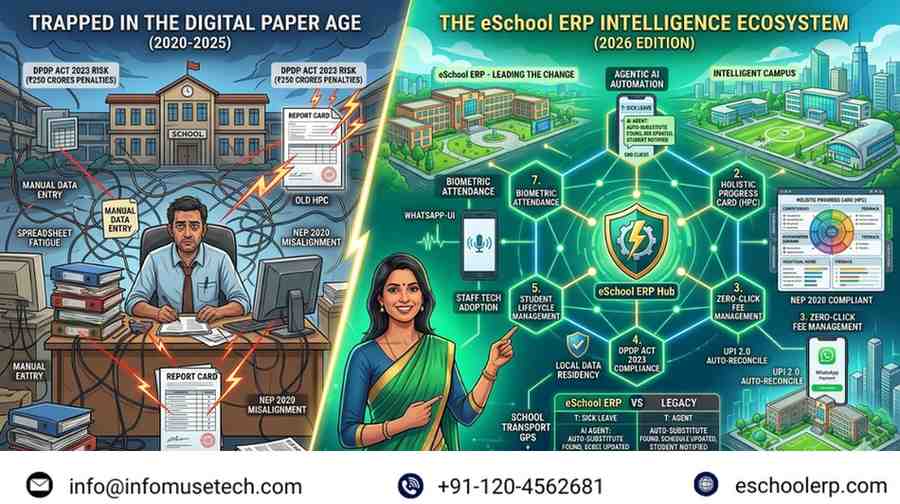
Education ERP Software in 2026: From Data Storage to Institutional Intelligence
1 thought on “The 2026 Student Management System Blueprint: Beyond Records to AI-Driven Success”